|
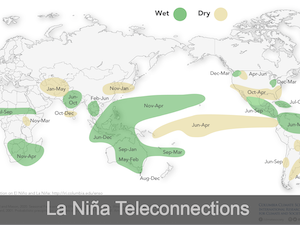
ENSO-Related Impacts
People often ask, "How will El Niño
(or La Niña) affect me?"
In terms of the climate impacts of El Niño/La Niña,
that question can be translated as "If there's an El Niño
(or a La Niña) event, what will the climate be like in a
particular season?". That answer will certainly vary by
region and season (3-month average, here). Also,
it is often difficult to identify what changes in seasonal climate
are caused explicitly by El Niño or La Niña events and what
changes are merely associated with those events through a
potential chain of impacts.
One can say that unusual weather events are the
direct result
of El Niño (or La Niña) only if that weather event
would not
have occurred in the absence of El Niño (or La Niña). In every
other case, the unusual weather that may seem related to the
occurrence of El Niño or La Niña, is an associated impact.
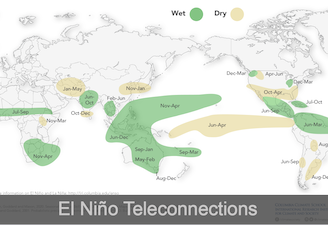
In particular, it is common during El Niño and La Niña events
to have persistent weather patterns that result in a particular
outcome for the seasonal climate. For example, it is common for
southern California to receive larger amounts of rain during an
El Niño in the January-February-March season. The increased rain,
in this case, generally falls as stronger and more frequent storms.
Clearly, it would rain in California regardless of El Niño, and
strong storms can occur in any year, and even frequent storms may
occur in non-El Niño winters. However, an El Niño event increases
the likelihood for stronger and more frequent storms, and is thus
associated with an increased probability for above normal rainfall
in that season. In other regions, more remote from the Pacific,
the repeatability of certain climate outcomes exists because the
atmospheric circulation changes induced by El Niño (or La Niña)
affects sea surface temperatures (SSTs) in other ocean basins.
One example of this remote association is eastern Africa where
rainfall variability is associated empirically with El
Niño/La Niña.
However, it is actually the Indian Ocean temperatures, which warm
or cool consistently with the tropical Pacific (El Niño/La Niña),
that are largely responsible for affecting the rainfall changes
over eastern Africa
(Goddard and Graham (1999)
).
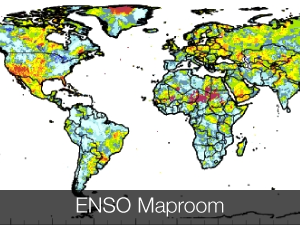
We have produced global probability
maps (a request form is at the top of this page)
that illustrate the probabilities of
seasonal temperature and precipitation outcomes that are associated
with El Niño and La Niña. The maps are based on historical
observed data of temperature and precipitation during the 1950-1995 period.
Over that 46 year period we determine the wettest one-third of the
years ("above-normal") the driest one-third of the years ("below-normal")
and the middle one-third ("near-normal"), at each location and for each
3-month season (e.g. JFM, FMA, ...., DJF). An identical procedure is
applied to the temperature fields. Next, we identify the strongest
10 El Niño events and the strongest 10 La Niña events, for
each of the 12 seasons, and examine the temperature and precipitation in
those 10 events.
The probability maps
show the frequency of years that above-normal,
near-normal, and below-normal temperature and precipitation occurred
during those top 10 El Niño and La Niña years (listed at
the bottom
of the figures with increasing magnitude from left to right). If one
locates an area on the "above-normal" precipitation map for El Niño
that shows a value of 0.5, that means that 1/2 or 50%
or 5 out of 10 of the past El Niño events resulted in above normal
precipitation for that area. The definition of how much rainfall,
in terms of percent of normal (200% = 2x normal), and how much
of a temperature departure is considered below normal or above normal
also depends on season and location.
One may interpret the probability maps as
indicating how the odds
for a particular climate outcome have shifted given an El Niño or
La Niña event. If one had no information about the climate, the
odds would be 33% or 0.33 or 1/3 or 1 in 3 chance of ending up in
any of the three categories (above-, near-, below-normal). However,
as an example, the maps show that over Florida in JFM 7 out of 10
(or 70%) La Niñas resulted in below normal rainfall. Thus, the odds
of receiving below-normal rainfall for Florida, in that case, more
than doubled. To the extent that what happened in the past is
representative of what will happen in the future, these maps can be
used to assess the seasonal climate probabilities associated with
El Niño and La Niña for each season.
The high resolution (0.5x0.5 degrees) data used
to make these maps of probabilistic climate anomalies associated with
El Niño and La Niña come from the Climate Research
Unit at the University of East Anglia (New, et al., 1999; New, et al., 2000).
The precipitation amounts have also been examined for several
locations identified as experiencing strong and repeatable
impacts during El Nino (Ropelewski and Halpert, 1987).
We have ploted the frequency of occurrence for rainfall
anomalies during El Nino years and during La Nina years.
The El Nino years are defined as the 20 warmest years
out of the last 100 (and La Nina as the 20 coldest years)
as indexed by tropical Pacific ocean temperature anomalies.
The distribution of these regional rainfall anomalies are
compared against the distribution of rainfall in all 100 years.
Another comparison is presented in which the El Nino and La Nina
anomalies are compared against the rainfall anomalies that
happen in a "normal year". "Normal years" are defined as
the 20 years (out of 100) in the middle, in which the
ocean temperatures in the tropical Pacific are near 0.
Tables are included with the plots that show the rainfall
and ocean temperature anomalies for the years included
in the plots (El Nino, La Nina, and "Normal" years).
Click on the region of interest.
Note: Region names are only approximate with respect to actual area covered,
which is noted specifically on all files.
Data Sources: - SST Data: Kaplan reconstructed global SST. 1856-1991 -
Precipitation Data:Global Historical Climate Data Network (GHCN) 1851-1989
Processing: In all cases, SST and precipitation anomalies were averaged over
months indicated in OGP web figure showing ENSO impacted areas (and noted in
filenames). The data sets were narrowed to include only 100 years, 1890-1989, to
insure consistent periods of data for the various regions. "El Nino" years were
defined to be the 20 years (20%-ile) in which the SSTa averaged
over NINO3 (5S-5N; 150W-90W), and over the months indicated, was the warmest.
Similarly for the La Nina (cold) years, shown in the probability distribution
plots.
|