CCSR/IRI ENSO Forecast
CCSR/IRI Technical ENSO Update and Model-Based Probabilistic ENSO Forecast
Published: January 20, 2026
Note: The SST anomalies cited below refer to the OISSTv2 SST data set, and not ERSSTv5. OISSTv2 is often used for real-time analysis and model initialization, while ERSSTv5 is used for retrospective official ENSO diagnosis because it is more homogeneous over time, allowing for more accurate comparisons among ENSO events that are years apart. These two products may differ, particularly during ENSO events. The difference between the two datasets may be as much as 0.5 °C. Additionally in some years, the ERSSTv5 may tend to be cooler than OISSTv2 in the context of warming trends, because ERSSTv5 is expressed relative to a base period that is updated every 5 years, while the base period of OISSTv2 is updated every 10 years. In February 2021, both datasets were updated to reflect the 1991-2020 climatology period.
Recent and Current Conditions
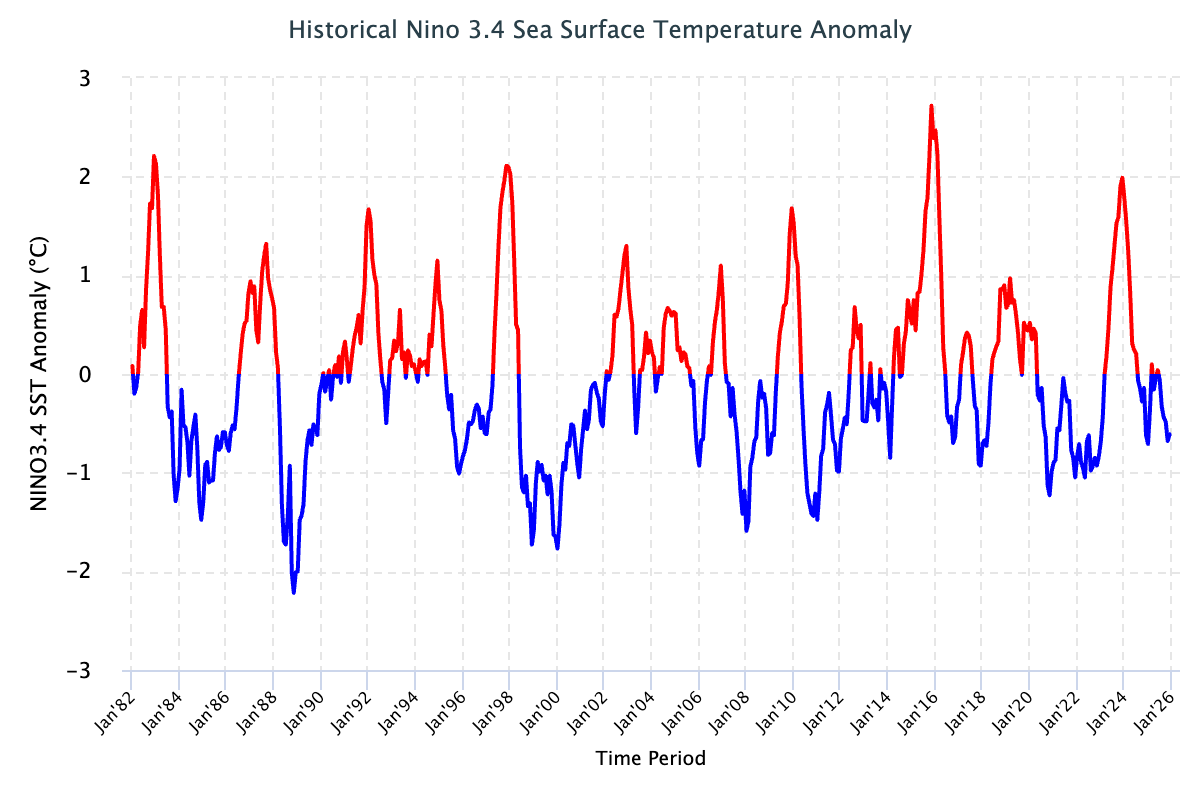
The observed SST anomaly in the NINO3.4 region during the Oct–Dec 2025 season was -0.59 °C, and for December 2025, it was -0.61 °C. The most recent weekly average (week centered on January 14, 2026) of the NINO3.4 index was -0.7 °C. These values indicate that Pacific sea-surface temperature anomalies have been experiencing weak La Niña conditions across the equatorial Pacific. The IRI’s definition of El Niño, similar to NOAA/Climate Prediction Center’s, requires that the monthly SST anomaly in the NINO3.4 region (5°S-5°N; 170°W-120°W) exceed +0.5 °C. Similarly, for La Niña, the anomaly must be -0.5 °C or colder.
By mid-January 2026, weak La Niña conditions have been present in both the atmosphere and ocean. In December 2025, the Southern Oscillation Index (SOI) was +0.1, while the equatorial SOI was +0.9, indicating a mismatch between the two indices during the month. However, the most recent 30-day (ending on 18 January 2026) SOI value is firmly within La Niña territory. Low-level winds (850 hPa) were blowing close to average across the east-central and eastern Pacific. Enhanced convection and increased rainfall were evident over parts of Indonesia, marked by below-average OLR, while suppressed convection and reduced precipitation dominated around the Date Line with above-average OLR. Subsurface temperature anomalies weakened during November and December 2025 but still remained negative in the far eastern Pacific (roughly 100°W–80°W). Meanwhile, above-average subsurface temperatures strengthened in the western half of the Pacific and expanded further eastward; however, the warming remained confined to depth and was relatively weak in magnitude.
Expected Conditions
Note – Only models that produce a new ENSO prediction every month are considered in this statement.
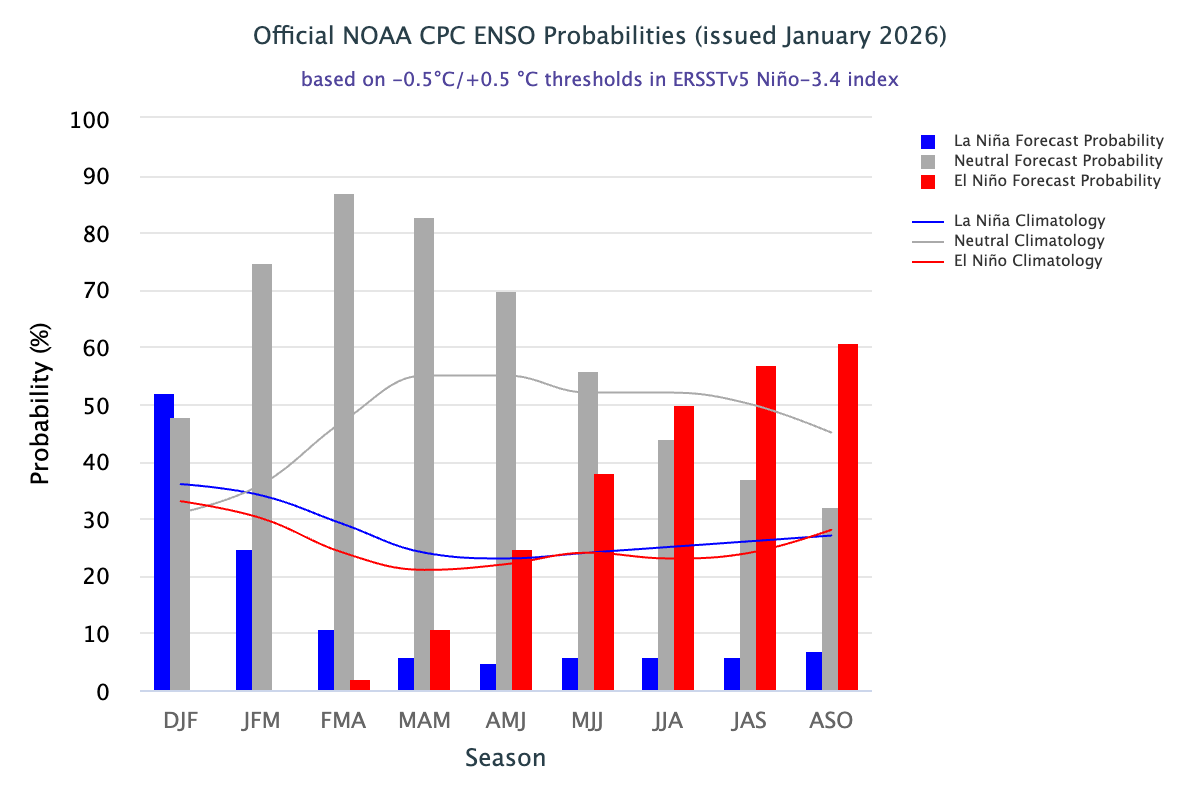
The El Niño/Southern Oscillation (ENSO) Diagnostic Discussion, released on 08 January 2026 by the Climate Prediction Center (CPC)/NCEP/NWS, maintained a “La Niña Advisory”, followed by a 75% chance of a transition to ENSO-neutral during January-March 2026, while ENSO-neutral is likely through at least Northern Hemisphere late spring 2026.
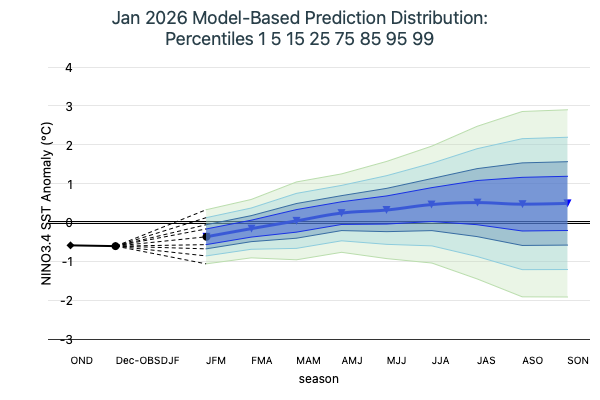
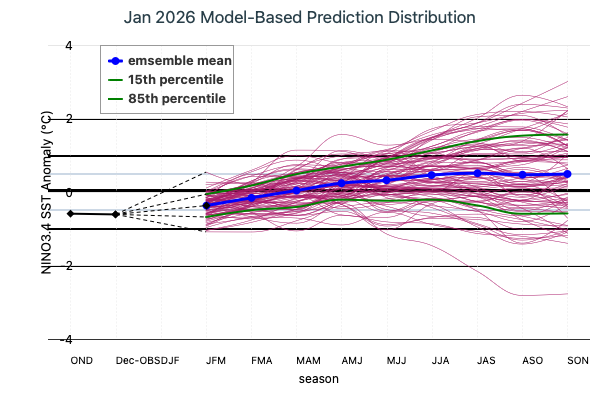
The latest set of ENSO prediction models from mid-January 2026 is now available in the CCSR IRI ENSO prediction plume. These are used to assess the probabilities of the three ENSO categories by using the average value of the NINO3.4 SST anomaly predictions from all models in the plume, equally weighted. A standard Gaussian error is imposed over that averaged forecast, with its width determined by an estimate of overall expected model skill for the season of the year and the lead time. Higher skill results in a relatively narrower error distribution, while low skill results in an error distribution with width approaching that of the historical observed distribution.
According to the January 2026 CCSR/IRI ENSO plume forecast, the probability of La Niña conditions persisting during Jan–Mar (JFM) 2026 is 31%, while ENSO-neutral conditions are the next most likely outcome, with an estimated probability of 69%. From Feb–Apr through May-Jul 2026, the outlook favors ENSO-neutral conditions, with probabilities ranging from 86% to 58% across the overlapping seasonal periods. During this period, La Niña probabilities remain low (between 13% to 5%), while the odds of El Niño gradually increase from 1% to 37% by May–Jul 2026. In the final four overlapping seasons of the forecast (Jun-Aug, Jul–Sep, Aug–Oct, and Sep–Nov), El Niño becomes the most likely outcome; however, probabilities remain low (between 48% to 51%), with ENSO-neutral the next most likely category. Caution is advised when interpreting these longer-lead ENSO forecasts, as they extend through the boreal spring predictability barrier; accordingly, long-range outlooks should be viewed with appropriate uncertainty, even if they suggest a possible emerging outcome. A plot of the probabilities summarizes the forecast evolution. The climatological probabilities for La Niña, ENSO-neutral, and El Niño conditions vary seasonally, and are shown by the lines on the plot, and are given in a table at the bottom of this page for each 3-month season.
Caution is advised in interpreting the forecast distribution from the Gaussian standard error as the actual probabilities, due to differing biases and performance of the different models. In particular, this approach considers only the mean of the predictions, and not the total range across the models, nor the ensemble range within individual models. At longer leads, the skill of the models degrades, and uncertainty in skill must be convolved with the uncertainties from initial conditions and differing model physics, which leads to more climatological probabilities in the long-lead ENSO Outlook than might be suggested by the suite of models. Furthermore, the expected skill of one model versus another has not been established using uniform validation procedures, which may cause a difference in the true probability distribution.
It is worth noting that the Relative Oceanic Niño Index (RONI), which measures sea surface temperature anomalies in the eastern equatorial Pacific relative to the rest of the equatorial band, has consistently and increasingly exceeded the −0.5 La Niña threshold for the past several overlapping seasons. For Jul–Sep, Aug–Oct, Sep–Nov, and Oct-Dec 2025, the RONI was -0.63, -0.77, -0.87, and -0.92 °C respectively. The Pacific Decadal Oscillation (PDO) Index in November 2025 recorded a value of −1.01.
A caution regarding the model-based ENSO plume predictions (released mid-month) is that factors such as known specific model biases and recent changes in the tropical Pacific that the models may have missed, are not considered. This approach is purely objective. Those issues are taken into account in CPC’s official outlooks, which are issued early in the month, and which will include some human judgment in combination with the model guidance.