| ||||||||||
Advanced ENSO Theory: The Delayed Oscillator
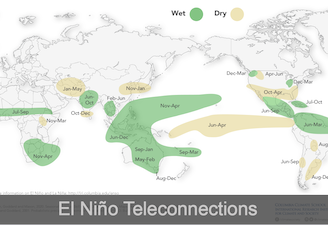
What Happens During El Niño?During El Niño warm events, the same interactions between the winds and the ocean come into play, but in reverse. The trade winds slacken, tending to reduce upwelling, and reduce the subsurface thermal contrast from west to east. A deepening warm water layer in the east results in warmer water being upwelled to the surface, and thus a surface warming in the east. But with warming in the east, the east-west SST contrast is reduced, convection become more ubiquitous throughout the domain, and the above mentioned circulation cell is largely disrupted, tending to reinforce the slackening of the trade winds. So once again, the oceanic and atmospheric anomalies feed back in a mutually reinforcing way, as an El Niño event amplifies.The positive feedback effect, by itself, would lead to an instability that would either “lock” the system into a permanent cold (La Niña) state or a warm (El Niño) state. The oscillatory mechanism inherent in the ocean dynamics, by itself, would lead to rather weak oscillations with periods of a few seasons. When the two processes are allowed to operate together, as in the real climate system (according to the theory), for a range of conditions that includes those observed in the tropical Pacific, coupled oscillations with enhanced amplitude and interannual periods (3-5 years) are favored. These heuristic arguments are supported by a number of theoretical and modeling studies that have demonstrated the plausibility of the theory, and provided quantitative results that could be validated against observations. In recent years, several variants of the above theory have been introduced, in which additional physical mechanisms are introduced. They give a somewhat refined interpretation of the physics introduced in the delayed oscillator theory, but still assign a fundamental importance to both the large-scale ocean dynamics, and the positive feedback mechanism. |