CCSR/IRI ENSO Forecast
CCSR/IRI Technical ENSO Update and Model-Based Probabilistic ENSO Forecast
Published: March 20, 2023
Note: The SST anomalies cited below refer to the OISSTv2 SST data set, and not ERSSTv5. OISSTv2 is often used for real-time analysis and model initialization, while ERSSTv5 is used for retrospective official ENSO diagnosis because it is more homogeneous over time, allowing for more accurate comparisons among ENSO events that are years apart. These two products may differ, particularly during ENSO events. The difference between the two datasets may be as much as 0.5 °C. Additionally in some years, the ERSSTv5 may tend to be cooler than OISSTv2 in the context of warming trends, because ERSSTv5 is expressed relative to a base period that is updated every 5 years, while the base period of OISSTv2 is updated every 10 years. In February 2021, both datasets were updated to reflect the 1991-2020 climatology period.
Recent and Current Conditions
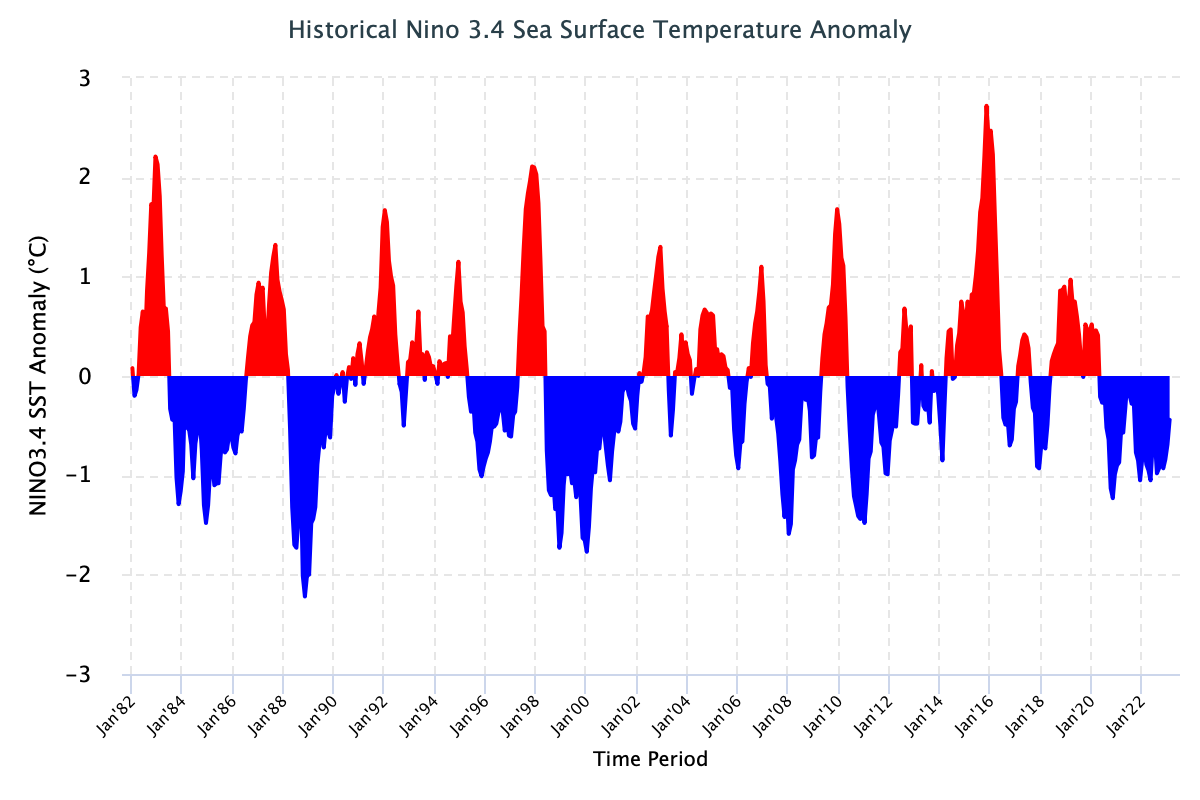
The SST anomaly for NINO3.4 during the Dec-Feb 2022 season was -0.65 °C, and for the month of February 2023 it was -0.44 °C. The most recent weekly (15 Mar 2023) anomaly in the NINO3.4 region was 0.1 °C, indicating termination of protracted triple-Dip La Niña. The tropical Pacific is now experiencing ENSO-neutral conditions. The IRI’s definition of El Niño, like NOAA/Climate Prediction Center’s, requires that the SST anomaly in the NINO3.4 region (5S-5N; 170W-120W) exceed 0.5 °C. Similarly, for La Niña, the anomaly must be -0.5 °C or colder.
The key atmospheric variables are now indicative of ENSO-neutral conditions, including the traditional and equatorial Southern Oscillation Indices, which are both weakly positive (as of 18 March 2023, the last observed value of the traditional Southern Oscillation Index was +1.0), the low-level easterly winds have weakened in the central and western Pacific, and have reversed in the eastern Pacific. The upper-level wind anomalies remain westerly across the tropical Pacific, dry conditions have been observed over the central and western Pacific Ocean, while dry conditions are also evident over Indonesia. In the ocean, positive subsurface temperature anomalies have expanded to cover the entire equatorial Pacific Ocean. In summary, the tropical Pacific is now in a neutral ENSO state.
Expected Conditions
Note – Only models that produce a new ENSO prediction every month are considered in this statement.
What is the outlook for the ENSO status going forward?
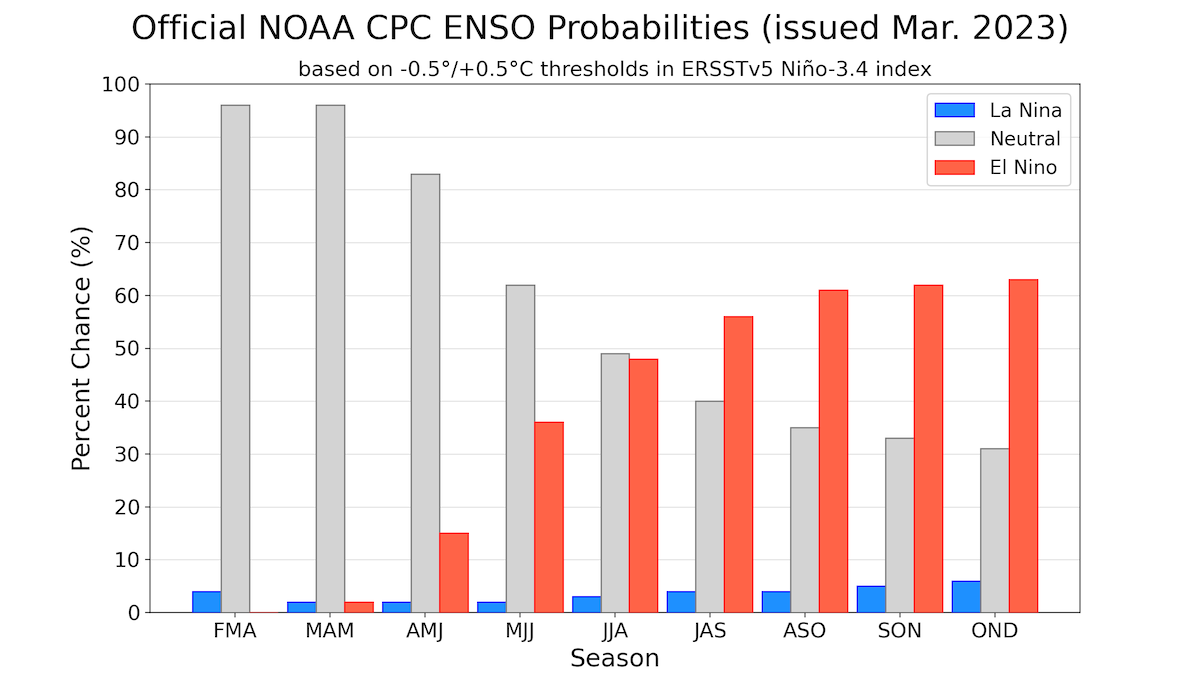
El Niño/Southern Oscillation (ENSO) Diagnostic Discussion released on 09 March 2023 by the Climate Prediction Center/NCEP/NWS issued a “Final La Niña Advisory”, and a continuation of ENSO-neutral conditions during Northern Hemisphere spring and early summer 2023.
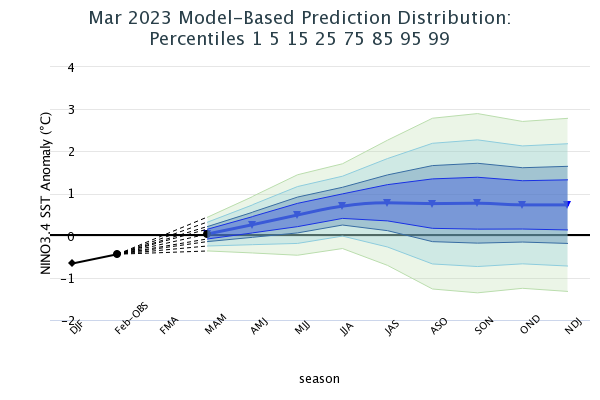
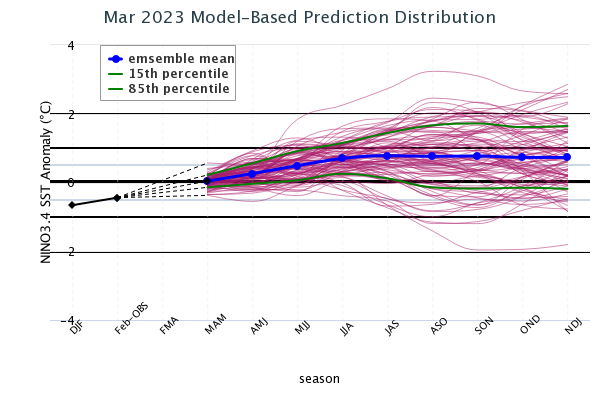
The latest set of ENSO prediction models from mid-March 2023 is now available in the IRI ENSO prediction plume. These are used to assess the probabilities of the three ENSO categories by using the average value of the NINO3.4 SST anomaly predictions from all models in the plume, equally weighted. A standard Gaussian error is imposed over that average forecast, and its width is determined by an estimate of overall expected model skill for the season of the year and the lead time. Higher skill results in a relatively narrower error distribution, while low skill results in an error distribution with width approaching that of the historical observed distribution.
The majority of models in the plume predict ENSO-neutral sea surface temperatures during Apr-Jun 2023. The probability of ENSO-neutral is 78% in Apr-Jun, and 50% in May-Jul, while that of the El Niño is 21% and 49% respectively; no models predict a continuation of La Niña. Going forward, El Niño conditions are highly favored during rest of the forecast period with probabilities in the range of 60-67%. The chances of La Niña recurring are very low in the entire forecast period (less than 10%). A plot of the probabilities summarizes the forecast evolution. The climatological probabilities for La Niña, ENSO-neutral, and El Niño conditions vary seasonally, and are shown by the lines on the plot, and are given in a table at the bottom of this page for each 3-month season.
Caution is advised in interpreting the forecast distribution from the Gaussian standard error as the actual probabilities, due to differing biases and performance of the different models. In particular, this approach considers only the mean of the predictions, and not the total range across the models, nor the ensemble range within individual models. At longer leads, the skill of the models degrades, and uncertainty in skill must be convolved with the uncertainties from initial conditions and differing model physics, which leads to more climatological probabilities in the long-lead ENSO Outlook than might be suggested by the suite of models. Furthermore, the expected skill of one model versus another has not been established using uniform validation procedures, which may cause a difference in the true probability distribution.
In summary, the probabilities derived from the models in the IRI ENSO forecast plume indicate ENSO-neutral during Apr-Jun (78% chance), and May-Jul (50% chance), while the chances of El Niño are 21%, and 49% respectively. The onset of El Niño is forecasted to be highly likely in Jun-Aug 2023 (64% chances), and its continuation during the rest of the forecast period (67% in Jul-Sep, 64% in Aug-Oct, 63% in Sep-Nov, and 60% during Oct-Dec, and Nov-Jan, 2023). The chance of La Niña re-emerging are low (just under 10%) during the entire forecast period.
A caution regarding the model-based ENSO plume predictions released mid-month, is that factors such as known specific model biases and recent changes in the tropical Pacific that the models may have missed, are not considered. This approach is purely objective. Those issues are taken into account in the official outlooks, which are generated and issued early in the month by CPC, and which will include some human judgment in combination with the model guidance.