ENSO Forecast Navigation

ENSO Forecasts

ENSO Forecast

October 2021 Quick Look

Published: October 19, 2021

A monthly summary of the status of El Niño, La Niña, and the Southern Oscillation, or ENSO, based on the NINO3.4 index (120-170W, 5S-5N)

In mid-October, SSTs in the central-eastern equatorial Pacific are -0.8 C different from average. The evolution of key oceanic and atmospheric variables is consistent with La Niña conditions, and therefore, a La Niña Advisory has been issued for Oct 2021. A large majority of the models predict SSTs to cool further through boreal autumn and winter, and then return to ENSO-neutral levels during spring. Similar to the most-recent official CPC/IRI ENSO Outlook issued on October 14, this objective model-based ENSO outlook also anticipates a La Niña event with high probability during Oct-Dec and persisting until Jan-Mar, with a return to ENSO-neutral conditions with high probabilities for rest of the forecast period.

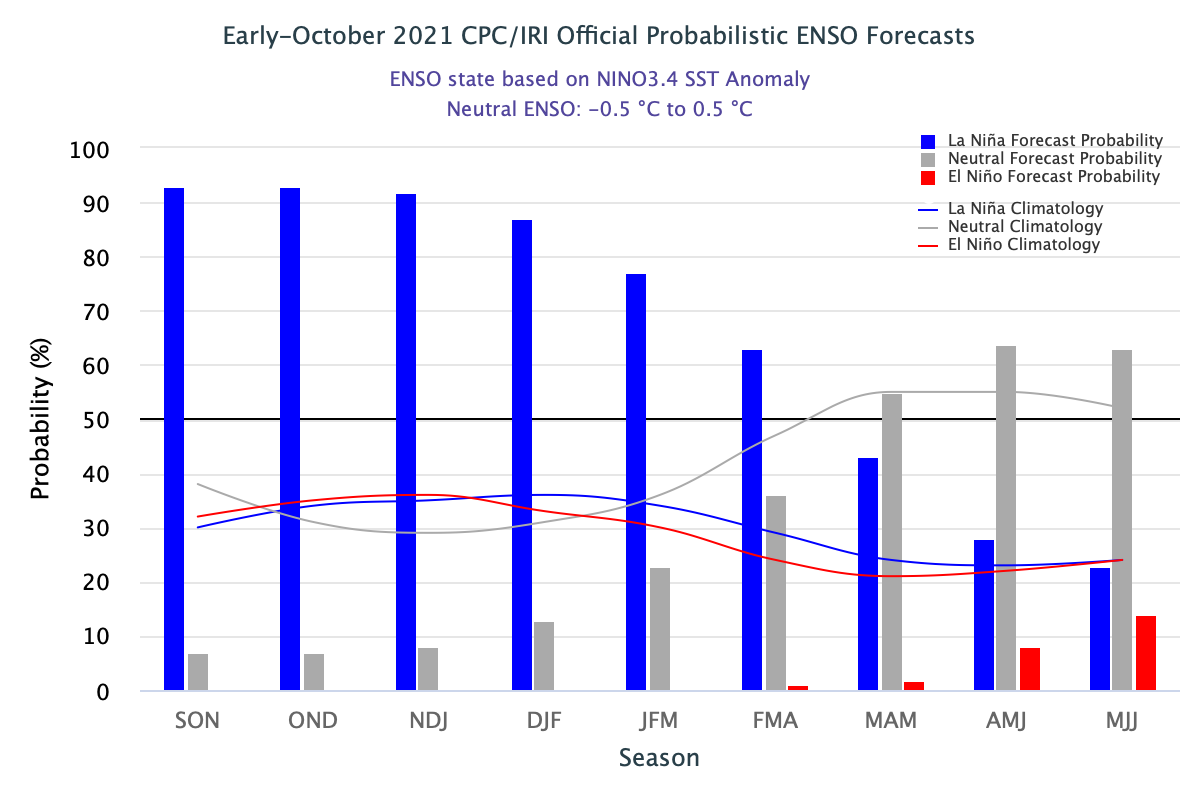
Figures 1 ((the official CPC ENSO probability forecast) and 3 (the objective model-based IRI ENSO probability forecast) are often quite similar. However, occasionally they may differ noticeably. There can be several possible reasons for differences. One is the human forecasters, using their experience and judgment, may disagree to some degree with the models, which may have known biases. Another reason is the models are not run at the same time that the forecasters make their assessment, so that the starting ENSO conditions may be slightly different between the two times. The charts on this Quick Look page are updated at two different times of the month, typically about a week apart, with the IRI forecast run later. Also note that the CPC forecast starts on the previous season while the IRI forecast starts on the current season.
Click on the for more information on each figure.

Historically Speaking

    El Niño and La Niña events tend to develop during the period Apr-Jun and they
  • Tend to reach their maximum strength during October - February
  • Typically persist for 9-12 months, though occasionally persisting for up to 2 years
  • Typically recur every 2 to 7 years

ENSO Forecast

CPC ENSO Update

Published: October 14, 2021

El Niño/Southern Oscillation (ENSO) Diagnostic Discussion issued by the Climate Prediction Center/NCEP/NWS

ENSO Alert System Status: La Niña Advisory

Synopsis: La Niña conditions have developed and are expected to continue with an 87% chance of La Niña in December 2021- February 2022.  

In the past month, La Niña conditions emerged, as indicated by below-average sea surface temperatures (SSTs) across the central and east-central equatorial Pacific (Fig. 1). In the last week, the Niño-3.4 and Niño-4 index values were -0.6ºC and -0.7ºC, respectively (Fig. 2). The Niño-3 and Niño-1+2 indices were not as cool, with values at -0.3ºC and 0.1ºC.  Below-average subsurface temperatures (averaged from 180-100ºW) strengthened significantly in the past month (Fig. 3), as negative anomalies were observed at depth across most of the central and eastern Pacific Ocean (Fig. 4). Low-level easterly wind anomalies and upper-level westerly wind anomalies were observed over most of the equatorial Pacific.  Tropical convection was suppressed near and west of the Date Line and enhanced over Indonesia (Fig. 5), while the Southern Oscillation Index and Equatorial Southern Oscillation Index were both positive. Overall, the coupled ocean-atmosphere system was consistent with La Niña conditions.

The IRI/CPC plume average of forecasts for the Niño-3.4 SST index favors La Niña to continue through the fall and winter 2021-22 (Fig. 6). The forecaster consensus also anticipates La Niña to continue through the winter, with ENSO-neutral predicted to return during March-May 2022.  Because of the recent oceanic cooling and coupling to the atmosphere, forecasters now anticipate a 57% chance of one season (November-January) reaching -1.0ºC or less in the Niño-3.4 index.  Thus, at its peak, a moderate-strength La Niña is favored.  In summary, La Niña conditions have developed and are expected to continue with an 87% chance of La Niña in December 2021- February 2022 (click CPC/IRI consensus forecast for the chances in each 3-month period).

La Niña is anticipated to affect temperature and precipitation across the United States during the upcoming months (the 3-month seasonal temperature and precipitation outlooks will be updated on Thurs. October 21st).

This discussion is a consolidated effort of the National Oceanic and Atmospheric Administration (NOAA), NOAA’s National Weather Service, and their funded institutions. Oceanic and atmospheric conditions are updated weekly on the Climate Prediction Center web site (El Niño/La Niña Current Conditions and Expert Discussions). Additional perspectives and analysis are also available in an ENSO blog.  A probabilistic strength forecast is available here.

The next ENSO Diagnostics Discussion is scheduled for 11 November 2021. To receive an e-mail notification when the monthly ENSO Diagnostic Discussions are released, please send an e-mail message to: ncep.list.enso-update@noaa.gov.


NOAA?CPC ENSO Forecast Image
Season La Niña Neutral El Niño
SON 93 7 0
OND 93 7 0
NDJ 92 8 0
DJF 87 13 0
JFM 77 23 0
FMA 63 36 1
MAM 43 55 2
AMJ 28 64 8
MJJ 23 63 14

IRI ENSO Forecast

IRI Technical ENSO Update and Model-Based Probabilistic ENSO Forecast

Published: October 19, 2021

Note: The SST anomalies cited below refer to the OISSTv2 SST data set, and not ERSSTv5. OISSTv2 is often used for real-time analysis and model initialization, while ERSSTv5 is used for retrospective official ENSO diagnosis because it is more homogeneous over time, allowing for more accurate comparisons among ENSO events that are years apart. These two products may differ, particularly during ENSO events. The difference between the two datasets may be as much as 0.5 C. Additionally in some years, the ERSSTv5 may tend to be cooler than OISSTv2 in the context of warming trends, because ERSSTv5 is expressed relative to a base period that is updated every 5 years, while the base period of OISSTv2 is updated every 10 years. In February 2021, both datasets were updated to reflect the 1991-2020 climatology period.

Recent and Current Conditions

In mid-October 2021, Sea Surface Temperature (SST) anomalies are below average across most of the equatorial Pacific Ocean. The September and Jul-Sep SST anomalies in NINO3.4 region (5S-5N; 170W-120W) were close to average, however, the most recent weekly (13OCT2021) SST anomaly was -0.8 C, which is well below average and is within the weak La Niña range. The IRI’s definition of La Niña, like NOAA/Climate Prediction Center’s, requires that the SST anomaly in the NINO3.4 region must be -0.5 C or less. Similarly, for El Niño the SST anomaly should exceed +0.5 C. The climatological probabilities for La Niña, neutral, and El Niño conditions vary seasonally, and are shown in a table at the bottom of this page for each 3-month season. The most recent observations of key oceanic and atmospheric variables are consistent with La Niña conditions. Subsurface ocean temperatures are below-average, with anomalies intensified and shifted from the central to the eastern Pacific. The traditional and equatorial Southern Oscillation Indices have been showing sustained positive values closer to the level of a weak La Niña event, and above-normal Trade Winds are observed near and west of the Date line. The upper-level westerly wind anomalies that would accompany a large-scale response to La Niña conditions are now present, together with reduced cloudiness near the date line and increased rainfall over Indonesia, all of which are consistent with La Niña conditions.

In summary, current conditions are decidedly indicative of a second La Niña event and hence, CPC announced a La Niña Advisory for Oct 2021.

Expected Conditions

Note – Only models that produce a new ENSO prediction every month are considered in this statement.

What is the outlook for the ENSO status going forward? The most recent official diagnosis and outlook was issued on 14 October 2021 in the NOAA/Climate Prediction Center ENSO Diagnostic Discussion, produced jointly by CPC and IRI; it states that La Niña conditions have been developed and are forecasted to continue during the coming Northern Hemisphere winter and into the early spring of 2022.

The latest set of model ENSO predictions from mid-October is now available in the IRI/CPC ENSO prediction plume. These are used to assess the probabilities of the three possible ENSO conditions by using the average value of the NINO3.4 SST anomaly predictions from all models on the plume, equally weighted. Currently, however, the NASA-GMAO model is not factored into the probabilistic update, even though it appears on the ENSO plume-of-models graphic. A standard Gaussian error is imposed over that average forecast, and its width is determined by an estimate of overall expected model skill for the season of the year and the lead time. Higher skill results in a relatively narrower error distribution, while low skill results in an error distribution with width approaching that of the historical observed distribution.

Using this method, chances for La Niña are 81% for the Oct-Dec season, while chances for ENSO-neutral is just 19%. Going forward, probabilities for La Niña decrease to 79% for Nov-Jan, 72% for Dec-Feb, 60% for Jan-Mar, 42% for Feb-Apr, and in the range of 24-15% for the rest of the forecast period. Chances for neutral ENSO state rise above 50% beginning in Feb-Apr, reaching above 70% for Mar-May and Apr-Jun, and decreasing to 50-60% afterwards;thus, the ENSO-neutral state becomes the most likely outcome from Feb-Apr 2022 onwards. Both dynamical and statistical models agree well on the likelihood of a second La Niña. El Niño probabilities start at 1% in Jan-Mar and slowly rise to around 30% by Jun-Aug. A plot of the probabilities summarizes the forecast evolution.

Caution is advised in interpreting the forecast distribution from the Gaussian standard error as the actual probabilities, due to differing biases and performance of the different models. In particular, this approach considers only the mean of the predictions, and not the total range across the models, nor the ensemble range within individual models. At longer leads, the skill of the models degrades, and uncertainty in skill must be convolved with the uncertainties from initial conditions and differing model physics, which leads to more climatological probabilities in the long-lead ENSO Outlook than might be suggested by the suite of models. Furthermore, the expected skill of one model versus another has not been established using uniform validation procedures, which may cause a difference in the true probability distribution.

In summary, the probabilities derived from the models on the IRI/CPC plume indicate a high preference for La Niña relative to neutral conditions during boreal winter and possibly extending into the early spring of 2022, after which neutral ENSO conditions again becomes the most likely outcome through the remaining forecast periods. The likelihood for El Niño development remains very low during winter and spring time, however, it increases up to 30% at the end of the forecast period.

A caution regarding the model-based ENSO plume predictions released mid-month, is that factors such as known specific model biases and recent changes in the tropical Pacific that the models may have missed, are not considered. This approach is purely objective. Those issues are taken into account in the official outlooks, which are generated and issued early in the month by CPC and IRI, and which will include some human judgment in combination with the model guidance.

IRI ENSO Forecast Histogram Image
Season La Niña Neutral El Niño
OND 81 19 0
NDJ 79 21 0
DJF 72 28 0
JFM 60 39 1
FMA 42 56 2
MAM 24 72 4
AMJ 15 74 11
MJJ 14 63 23
JJA 15 53 32

ENSO Forecast

IRI ENSO Predictions Plume

Published: October 19, 2021

Note on interpreting model forecasts

The following graph and table show forecasts made by dynamical and statistical models for SST in the Nino 3.4 region for nine overlapping 3-month periods. Note that the expected skills of the models, based on historical performance, are not equal to one another. The skills also generally decrease as the lead time increases. Thirdly, forecasts made at some times of the year generally have higher skill than forecasts made at other times of the year--namely, they are better when made between June and December than when they are made between February and May. Differences among the forecasts of the models reflect both differences in model design, and actual uncertainty in the forecast of the possible future SST scenario.

Interactive Chart

You can highlight a specific model by hovering over it either on the chart or the legend. Selecting An item on the legend will toggle the visibility of the model on the page. You can also select DYN MODELS or STAT MODELS to toggle them all at once. Clicking on the "burger" menu above the legend will give you options to download the image or expand to full screen. If you have any feedback on this new feature, please let us know at webmaster@iri.columbia.edu.


List of Models Used


Forecast SST Anomalies (deg C) in the Nino 3.4 Region

Seasons (2021 – 2022)
Model OND NDJ DJF JFM FMA MAM AMJ MJJ JJA
Dynamical Models
NASA GMAO -2.46 -2.73 -2.44 -1.85 -1.38 -0.95 -0.60
NCEP CFSv2 -1.05 -1.54 -1.70 -1.61 -1.29 -0.89 -0.51
JMA -1.08 -1.14 -1.07 -0.79 -0.47
BCC_CSM11m -0.97 -0.60 -0.13 0.27 0.59 0.88 1.17 1.47 1.77
SAUDI-KAU -1.22 -0.96 -0.68 -0.50 -0.37 -0.25 -0.14 -0.09 -0.08
LDEO -0.15 -0.11 0.02 0.19 0.29 0.31 0.31 0.33 0.35
AUS-ACCESS -0.92 -1.00 -0.87 -0.60
ECMWF -0.79 -0.77 -0.69 -0.51 -0.25
UKMO -0.91 -0.97 -0.85 -0.66
KMA -1.22 -1.30 -1.17 -0.96 -0.74
IOCAS ICM -0.56 -0.59 -0.62 -0.59 -0.51 -0.43 -0.37 -0.33 -0.28
COLA CCSM4 -1.28 -1.52 -1.65 -1.50 -1.12 -0.74 -0.44 -0.26 -0.10
MetFRANCE -0.77 -0.86 -0.86 -0.67 -0.47 -0.22 0.01
SINTEX-F -0.16 -0.12 -0.04 0.08 0.23 0.39 0.53 0.65 0.75
CS-IRI-MM -0.72 -0.81 -0.78 -0.61 -0.34 -0.08
GFDL SPEAR -0.62 -0.68 -0.62 -0.45 -0.22 -0.02 0.14 0.28 0.32
CMC CANSIP -0.95 -1.10 -1.13 -1.03 -0.81 -0.62 -0.44 -0.27 -0.05
Average, Dynamical models -0.93 -0.99 -0.90 -0.69 -0.46 -0.22 -0.03 0.22 0.33
Statistical Models
NTU CODA -0.45 -0.50 -0.55 -0.54 -0.37 -0.22 -0.12 0.00 0.10
BCC_RZDM -1.08 -1.20 -1.26 -1.22 -1.01 -0.72 -0.37 -0.09 0.13
CPC MRKOV -0.96 -0.84 -0.69 -0.54 -0.43 -0.30 -0.17 -0.05 0.05
CPC CA -0.46 -0.46 -0.35 -0.24 -0.03 0.07 0.13 0.12 0.07
CSU CLIPR -0.63 -0.62 -0.60 -0.59 -0.45 -0.32 -0.18 -0.13 -0.08
IAP-NN -0.79 -0.85 -0.85 -0.78 -0.65 -0.51 -0.35 -0.21 -0.11
FSU REGR
UCLA-TCD -0.62 -0.66 -0.60 -0.47 -0.29 -0.13 -0.01 0.06 0.07
Average, Statistical models -0.71 -0.73 -0.70 -0.63 -0.46 -0.30 -0.15 -0.04 0.03
Average, All models -0.87 -0.91 -0.84 -0.67 -0.46 -0.25 -0.08 0.10 0.19

Discussion of Current Forecasts

A broad majority of the models in the set of dynamical and statistical model predictions issued during mid-October 2021 show weak-to-moderate La Niña SST anomalies for the remainder of 2021, likely fading to weak La Niña during late winter and early spring time, and return to neutral state in late spring and early summer. In the most recent week, the SST anomaly in the NINO3.4 regions was -0.8 C, showing borderline weak La Niña state, and -0.29 C for the month of September, just in the near neutral range.

Dynamical and statistical models show consistent La Niña conditions with 70% likelihood during boreal winter time, and then decreasing in early spring of 2022. ENSO-neutral conditions are again more likely category than La Niña during rest of forecast period. Based on the multi-model mean prediction, and the expected skill of the models by start time and lead time, the probabilities (X100) for La Niña, neutral and El Niño conditions (using -0.5 C and 0.5 C thresholds) over the coming 9 seasons are:

Season La Niña Neutral El Niño
OND 81 19 0
NDJ 79 21 0
DJF 72 28 0
JFM 60 39 1
FMA 42 56 2
MAM 24 72 4
AMJ 15 74 11
MJJ 14 63 23
JJA 15 53 32

Summary of forecasts issued over last 22 months

The following interactive plot shows the model forecasts issued not only from the current month (as in the plot above), but also from the 21 months previous to this month. The observations are shown up to the most recently completed 3-month period. The plots allow comparison of plumes from the previous start times, or examination of the forecast behavior of a given model over time.
Hovering over any single model will highlight that particular model in the chart.
Clicking a particular model will hide/show that model in the chart.
At the bottom of the plot, you can select which models to show in the chart: all the models, the dynamical models only, or the statistical models only.


Notes on the data 

Only models producing forecasts on a monthly basis are included. This means that some models whose forecasts appear in the Experimental Long-Lead Forecast Bulletin (produced by COLA) do not appear in the table.

Once an IRI ENSO probability forecast has been published, the results stand even if a model reports an error and changes their data. When this happens we will update the plume with the model's correct values even though our forecast hasn't changed. What this means is that our forecast is always the same, but the underlying data may be different from what we based our forecast on.

The SST anomaly forecasts are for the 3-month periods shown, and are for the Nino 3.4 region (120-170W, 5N-5S). Often, the anomalies are provided directly in a graph or a table by the respective forecasting centers for the Nino 3.4 region. In some cases, however, they are given for 1-month periods, for 3-month periods that skip some of the periods in the above table, and/or only for a region (or regions) other than Nino 3.4. In these cases, the following means are used to obtain the needed anomalies for the table:

  • Temporal averaging
  • Linear temporal interpolation
  • Visual averaging of values on a contoured map

The anomalies shown are those with respect to the base period used to define the normals, which vary among the groups producing model forecasts. They have not been adjusted to anomalies with respect to a common base period. Discrepancies among the climatological SST resulting from differing base periods may be as high as a quarter of a degree C in the worst cases. Forecasters are encouraged to use the standard 1991-2020 period as the base period, or a period not very different from it.

ENSO Forecast

Forecast Probability Distribution Based on the IRI ENSO Prediction Plume

Published: October 19, 2021


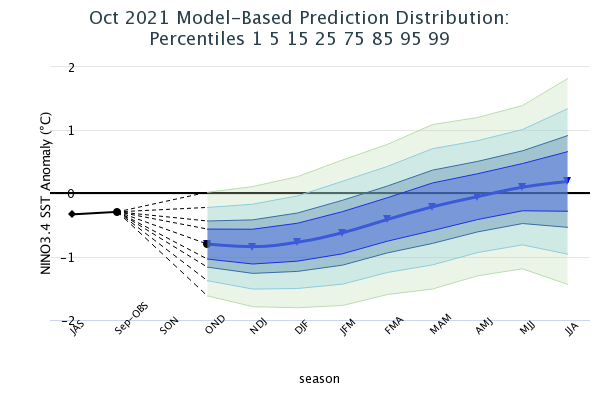
The plots on this page show predictions of seasonal (3-month average) sea surface temperature (SST) anomaly in the Niño3.4 region in the east-central tropical Pacific (5°N-5°S, 120°-170°W), covering the nine overlapping seasons beginning with the current month. The predictions are based on the large (20+) set of dynamical and statistical models in the plume of model ENSO predictions.


  • Model Based Prediction Percentiles Image

    Figure 5

    Predictions of ENSO are probabilistic. The ensemble mean prediction is only a best single guess. On either side of that prediction, there is a substantial uncertainty distribution, or error tolerance. The second plot (Figure 2) shows the estimated probability distribution of the predictions, showing a set of percentiles within that distribution for each lead time. The distribution is modeled as a normal (Gaussian) distribution, so that the overall mean forecast represents the center, or 50 percentile, in the distribution. The overall mean is formed using equal weighting among all models. On either side, other percentile values are shown symmetrically, ranging from 1 to 99 and including some intermediate percentiles (5 and 95, 15 and 85, and 25 and 75). The plot enables a user to estimate the probability of the Niño3.4 SST anomaly to be greater or less than some critical value, or within some interval. If, for example, the 85 percentile falls at 1.8° C above average, the probability of the SST exceeding 1.8° C can be estimated at 15%. Probabilities for exceeding or not exceeding values not exactly on percentile line can be roughly interpolated by eye. The overall width of the probability distribution is derived from the historical skill of the hindcasts of the models, from 1982 to present, for the specific forecast start time and lead time. This method of defining the probability distribution represents one of two general approaches, the other approach being a direct counting of ensemble members within each of the percentile bands. This second approach assumes that the ensemble spreads of the models are true representations of the uncertainty. Individual model spreads have often been found to be somwehate narrower than they should be, although in multi-model ensembles this tendency has been shown to be milder or even eliminated.

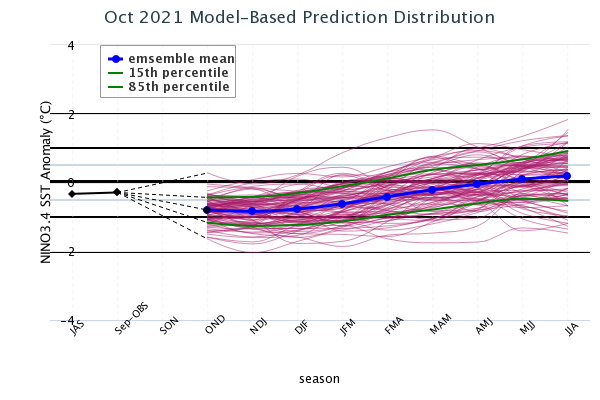
  • Model Based Prediction Distribution Image

    Figure 6

    Figure 6, sometimes called a spaghetti diagram, shows synthetically generated prediction scenarios that are equally likely. Here, 100 scenarios are shown; any number can be generated for such a diagram. Each scenario is produced using a random number generator, combined with knowledge of the mean forecast and its uncertainty, as well as the amount of persistence of anomalies. The degree of persistence of anomalies is based on the correlation of prediction errors from one lead time to another. In other words, the individual lines are designed to show the correct amount of persistence as expected in nature, rather than jumping around more randomly from one lead time to the next. The uncertainty and persistence statistics are based on the set of 7 NMME (North American Multimodel Ensemble) models, as it is assumed that these statistics are approximately applicable to all of the models. Sometimes the “spaghetti density” may appear asymmetric about the mean of all the forecasts or outside of the 85 and 15 percentile lines. This is purely sampling variability, and would not occur if many thousands of such lines were plotted. But with that many lines, most of the plot would be too crowded to get a sense of the behavior of the lines near the center of the distribution. The main purpose of the diagram is to serve users who want to assess realistic individual scenarios of ENSO behavior rather than statistical summaries of the forecast like the percentiles shown in the second plot.

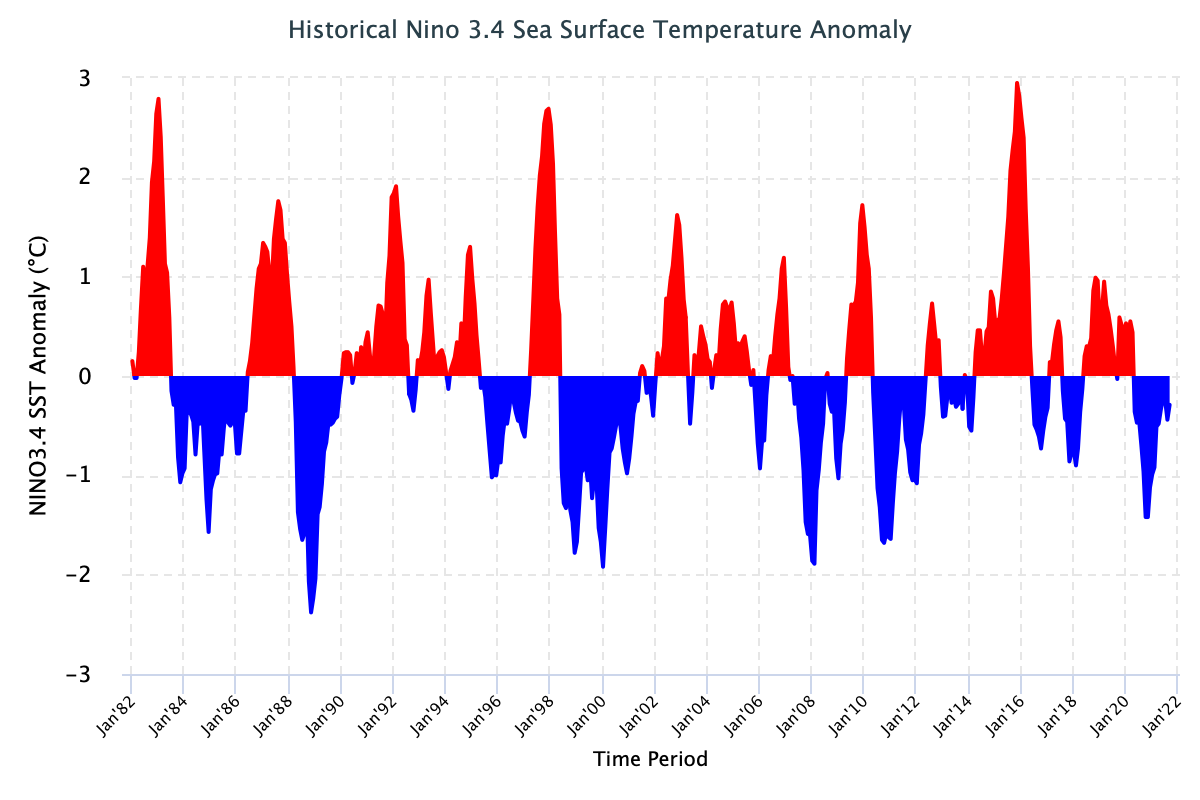
Historical SST Anomalies Image

References

Real-time ENSO forecast skill evaluated over the last two decades, with focus on the onset of ENSO events. Ehsan, M.A., L’Heureux, M.L., Tippett, M.K., Robertson, A.W, Turmelle, J.P., npj Clim Atmos Sci, 2024.

The IRI ENSO forecast is released on the 19th of each month. If the 19th falls on a weekend or holiday, it is released on the closest business day.

Forecast and model data used in our probabilistic forecast can be accessed by submitting a Request to Access IRI ENSO Data.

All data from this website is covered under the Creative Commons Attribution 4.0 License. When citing IRI ENSO images or data, please use "Images [or Data] provided by The International Research Institute for Climate and Society, Columbia University Climate School", with a link to https://iri.columbia.edu/ENSO.