| |||||||||
Responding to ENSOIdentifying Risks: A Disaster Management Approach
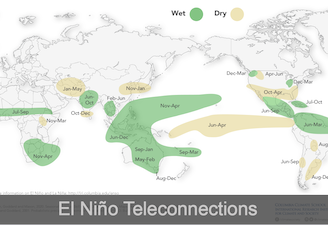
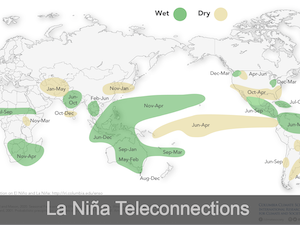
ENSO events can raise risks of losses in some geographic areas. In combination with other regional climate influences, ENSO creates regional climate anomalies. These anomalies may be expressed as hazard events such as droughts, heavy rains, flooding and extreme temperatures. Society is affected through the impacts of these anomalies in climate-sensitive sectors:
RiskSome regions of the worlds typically experience ENSO events as severe shocks with grave socio-economic consequences. Every ENSO event is different, however, and the socio-economic context also changes from event to event. Non-uniform climate and social scenarios from one event to another make it necessary to identify and plan for a range of possible outcomes.Assessing the risks for an approaching ENSO event involves indentifying possible outcomes by specifying:
HazardsNatural hazard events are described in terms of their magnitude, timing, location, duration and probability of occurrence. In addition to climate-related shocks -- such as droughts, floods, high winds and extreme temperatures -- economic and other exogenous shocks can also affect the elements at risk.Preparing for an ENSO event involves assessing the probabilities of various climate-related hazard events (see, and the ) in terms of the above characteristics. Additional sources of information on potential climatic hazards include regional organizations (see Resources) and national meteorological and hydrological services. See: VulnerabilityVulnerabilities are the characteristics of the elements at risk that make them susceptible to damage when exposed to a hazard event. It is important to recognize that losses are caused as much by the vulnerabilities of the elements at risk as they are by the hazard event itself.Major hazard events, such as the Mozambique floods of 2000, can affect hundreds of thousands of people across virtually every major sector. Loss of vulnerable assets leads to further, indirect, losses of production. Thus, the costs of hazard events in combination with unaddressed vulnerabilities can be quite high, rising to several percentage points of GDP in major disasters. Protecting social and economic assets from the hazard event can often prevent some portion of the direct losses and therefore of the indirect losses as well. Planners must attempt to calculate how much investment in loss prevention will be cost-effective given the prevailing risks arising during a given ENSO event. |