IRI Home

Overview of ENSO Impacts

What are ENSO impacts?
Why do we care about ENSO impacts?
What do we need to know about ENSO impacts?

What do we need to know about ENSO impacts?

>
Climate
>
Vulnerability
>
Seasonal Climate Forecasts

If there is a forecast of an El Niño or La Niña event, how do we know what impacts to expect? To anticipate future impacts, we need to identify and understand what affected the impacts in the past. You can find more detailed information on how to study ENSO impacts under the Methods section.

Climate

Because seasonal climate is the link that connects ENSO to its impacts on society, the strength of the relationship between ENSO and impacts depends on the strength of the relationship between ENSO and seasonal climate.

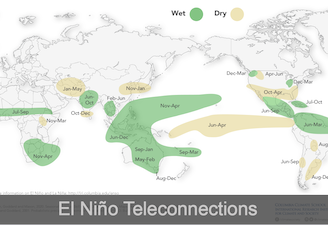
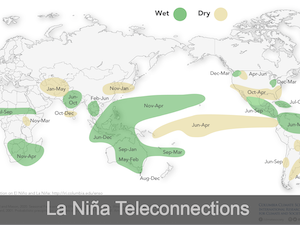
One of the basic characteristics of El Niño or La Niña events is that, over many events, they tend to shift the seasonal climate in a region in one direction; but the shift is never exactly the same in any two events. In some regions of the world (mainly in the tropics) the relationship between ENSO and seasonal climate is strong, where as in other it is much weaker. (See the ENSO and Climate section for much more detail.)

Similarly, some impacts are more likely during El Niño or La Niña events, but they are never exactly the same in any two events. So to anticipate what the impacts of future El Niño or La Niña events might be, we need to know how strong the relationship between ENSO and the impacts is.

Vulnerability

The same climate conditions can affect different people, or the same people at different times, in very different ways. This is because the effect of climate depends on what they do (say rainfed vs. irrigated agriculture), and the social, economic, political or environmental situation they are in (say during conflict vs. peace).

This simple idea, that the characteristics of a person or a group of people determine how they are affected by climate variability, is captured formally by concept of vulnerability. Vulnerability is the degree to which someone's life and livelihood is put at risk by a particular type climate event, given their capacity to anticipate, cope with, resist, and recover from the impacts of that event. (Adapted from Blaikie, Cannon, Davis, and Wisner (1994), "At Risk: Natural hazards, people's vulnerability, and disasters," Routledge.) For more information, see Identifying Risks.

Therefore, to anticipate the impacts of ENSO, we need to understand what characteristics make some people more like to be affected by ENSO-related climate anomalies.

Seasonal Climate Forecasts

In recent years, people have been using forecasts of El Niño or La Niña events, and their associated changes in climate conditions, to try to change the outcome of the events. In some cases their actions were successful, and in some cases not. Examining how past actions changed the impacts of El Niño or La Niña events is, therefore, crucial deciding what actions to take in the future. See also Responding to ENSO.