| |||||||||||
Overview of the Effects of ENSO on Climate
Climate Prediction
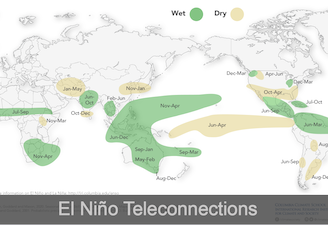
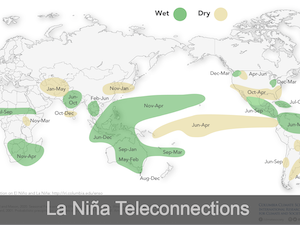
ENSO and seasonal climateThe state of the ENSO not only directly affects the climate in the tropical Pacific, but also affects the climate over many large regions of the world far removed from the Pacific through a chain of associated events that takes only a few weeks to occur once an El Niño or La Niña has established itself. About one-quarter of the globe is affected to a significant extent by ENSO, with more tropical and subtropical regions affected than higher latitude regions. There are known physical connections that cause the conditions of ENSO in the tropical Pacific to affect remote regions of the earth, and these connections can be reproduced in models of the ocean and the atmosphere. It is clear that knowing the ENSO condition ahead of time would provide substantial opportunities to provide useful climate forecasts for enough regions to make the effort worthwhile. Other influences on seasonal climateENSO is not the only ocean-atmosphere phenomenon that affects the climate. While it is the largest known source of year-to-year climate variability, there are other known causes of seasonal climate variability that have nothing to do with ENSO. For example, unusually warm or cold sea surface temperatures in the tropical Atlantic or Indian ocean (not related to ENSO) can cause major shifts in seasonal climate in nearby continents. For example, the sea surface temperature in the western Indian Ocean has a strong effect on the precipitation in tropical eastern Africa, and ocean conditions in the tropical Atlantic affect rainfall in northeast Brazil. In addition to the tropical oceans, other factors that may influence seasonal climate are snow cover and soil wetness. When snow cover is above average for a given season and region, it has a greater cooling influence on the air than usual. Soil wetness, which comes into play most strongly during the warm time of the year, also has a cooling influence. These two factors, while noticeable in their influence on climate, do not have as strong an effect as the tropical oceans do. Forecasting seasonal climateForecasts of the seasonal precipitation and temperature are made at the IRI for most of the globe every month. These forecasts depend primarily on the patterns of predicted sea surface temperature for the same future time, since sea surface temperatures in the tropics are the primary factor driving the forecasts for the atmosphere. The atmospheric models that are used in making seasonal predictions may be either dynamical or statistical in nature. If they are dynamical, they are called atmospheric general circulation models (AGCMs), since they forecast the large scale air flow patterns across the globe in order to determine the implied precipitation and temperature patterns going along with them. They apply the equations of atmospheric motion to the initial atmospheric observations, along with the sea surface temperature pattern, to calculate the forecast for a later time. The running of the AGCM often is done not once, but many (such as 10 or more) times, each using a slightly different atmospheric initial condition, to evaluate the differences among the resulting atmospheric forecasts. This practice, called ensemble forecasting, is done to get some idea of the uncertainty in the forecast. When all of the ensembles give a similar forecast result, there is reason to be more certain of the forecast than when they give very different results, which would suggest greater uncertainty in the forecast. The probabilities given in the precipitation and temperature forecasts reflect, in part, the differences (spread) among the ensemble members of the AGCM forecasts. Statistical seasonal forecast models are also in use. In this case, predictors such as the sea surface temperature in certain key regions (one of which might well be the Niño 3.4 region in the east-central tropical Pacific) may be used to infer climate consequences, based on correlations seen over the last 40 or so years. At the IRI, such statistical forecasts are often combined with the dynamical AGCM forecasts to produce a final prediction for the coming two seasons. |