IRI Home

Overview of the Effects of ENSO on Climate

ENSO influence on Climate
Climate Prediction
Links and References

The Influence of ENSO on Climate

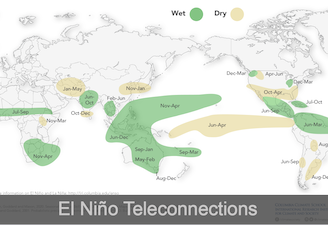
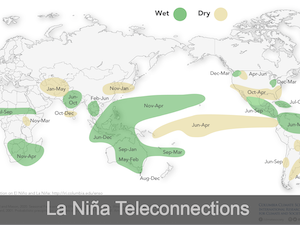
Once developed, El Niño and La Niña events are known to shift the seasonal temperature and precipitation patterns in many different regions of the world, even ones that are distant from the equatorial Pacific Ocean. These shifts are also know teleconnections.

Teleconnections occur because rainfall, which is associated with sea surface temperatures in the tropics (see ENSO Basics), affects wind patterns in the atmosphere. In the tropics, air that rises to form clouds and precipitation at a certain location must subside somewhere else (what goes up must come down). This is how one tropical region that is persistently wet, for example, can lead to another region being persistently dry. Shifts in tropical rainfall and winds can also affect regions outside of the tropics by altering prevailing wind patterns that circulate around the globe.

In several parts of the tropics, and some areas outside of the tropics, these seasonal shifts are fairly consistent from one El Niño and La Niña event to the next. It is important to remember, however, that no two El Niño or La Niña events are identical and that the seasonal shifts in temperature and precipitation patterns associated with them can vary from one event to the next. Thus, when an El Niño or La Niña  develops, it does not guarantee that regions which are typically affected by them will be affected, only  that there is enhanced probability that this will be the case.