ENSO Info
The Big Picture
The Simple Picture
ENSO
- ENSO, or the El Niño-Southern Oscillation, is a system
of interactions between the equatorial Pacific Ocean and the atmosphere above
it.
- The state of the ENSO system fluctuates from year to year. One
of the main ways we observe those fluctuations is through changes in the sea-surface
temperature of the equatorial Pacific Ocean.
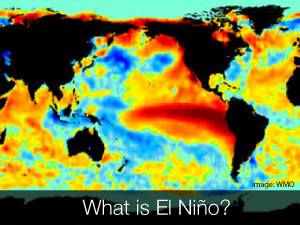
- El Niño and La Niña events are opposite states
of the ENSO system: El Niño is when the equatorial Pacific is warmer
than average, and La Niña is when it is cooler than average.
- Once an El Niño or La Niña event develops, it
tends to continue for about a year.
- You can find information about what ENSO is and how it works
in the ENSO System
section.
ENSO and seasonal climate
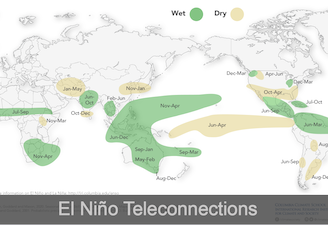
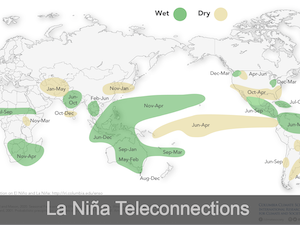
- Changes in the ENSO system in the Pacific Ocean influence the
seasonal climate (such as on rainfall and temperature) in many parts of the
world in a consistent way. In other words, depending on the region and season,
some climate conditions are more likely to happen during El Niño events
or during La Niña events than at other times.
- In many parts of the world, changes in the ENSO system are responsible
for a large fraction of changes in the local climate from year to year.
- Because ENSO events tend to continue for a year, and because
they generally influence climate in a consistent way, we can use ENSO information
to forecast the climate.
- You can learn more about how ENSO affects seasonal climate
and about its specific regional effects in the
ENSO and Climate
section.
ENSO and Society
- By making some climate conditions more likely during El Niño
or La Niña events, ENSO also makes the societal and environmental effects
(or "impacts") of these conditions more likely.
- Climate conditions associated with ENSO have a wide range of
impacts (both good and bad): on agricultural production, water availability,
disease outbreaks, fisheries catches, energy demand and supply, food availability,
and many others.
- We can use forecasts of ENSO-related climate conditions to plan
ahead to prevent the damage that they may cause, or to take advantage of good
conditions that they may bring.
- You can find more information on the impacts of ENSO evens and
how we can respond to them in the ENSO and Society
section.
The More Realistic Picture
The effects of ENSO on seasonal climate conditions, and the effects of these
climate conditions on society, are often consistent, but they are modulated
by many other factors.
- The frequency and strength of ENSO events, and the relative number
of El Niño and La Niña events, are known to vary on time scales
of decades and longer. There are also suggestions that global warming could
change these characteristics of ENSO, but there is little consensus on what
these changes might be.
- ENSO is only one of several influences on seasonal climate, so
the climate is never exactly the same in any two events, even in regions
that are strongly influenced by ENSO. Other influences on seasonal climate
include sea-surface temperatures in other ocean basins (like the Atlantic
or Indian Ocean), sea-ice extent in the polar regions, and snow cover in
high latitudes (like the in Tibetan Plateau). Furthermore, the way ENSO influences
seasonal climate has changes over time. For example, El Niño events
were closely associated with the failure of the Indian monsoon in the late
1800s and early 1900s, but the association disappeared for the rest of the
1900s.
- Seasonal climate, and therefore ENSO, is only one of many factors
that affect people and their environment. For example, there are almost always
other factors contributing to the occurrence of famines than failure of rainfall
alone—such as government policies, crop and human diseases, lack of credit,
conflict, unfavorable markets, debt, disruption of storage and shipping facilities,
and many others. Another, more recent, factor that modulates the effects
of ENSO events are the preparatory actions people take in response to seasonal
climate forecasts. All these circumstances can change from one ENSO event
to another and so can change the impacts of the event. They also add a higher
degree of complexity to understanding ENSO impacts.
Beyond ENSO
ENSO is not the only thing that influences seasonal climate and its impacts.
Therefore,
- We can forecast some of those non-ENSO climate fluctuations,
which means that we can use seasonal climate forecasts even when no El Niño
or La Niña event is occurring.
- We will probably never be able to predict every climate fluctuation
that occurs, so we should aim towards always being prepared for any possibility.
- We need to look beyond ENSO at general seasonal climate variability
and the impacts it has on society and the environment.
|