IRI Home

Overview of the ENSO System

ENSO Basics
Monitoring ENSO
Defining ENSO
Predicting ENSO
Links and References

ENSO Basics

>
What are El Niño and La Niña?
>
What is ENSO?
>
Why do we care about El Niño and La Niña?

What are El Niño and La Niña?

The term El Niño was first coined more than 100 years ago to describe the unusually warm waters that would occasionally form along the coast of Ecuador and Peru. This phenomenon typically occurred late in the calendar year near Christmas, hence the name El Niño (spanish for "the boy child", referring to the Christ child). Today the term El Niño is used to refer to a much broader scale phenomenon associated with unusually warm water that occasionally forms across much of the tropical eastern and central  Pacific. The time between successive El Niño events is irregular but they typically tend to recur every 3 to 7 years.

La Niña is the counterpart to El Niño and is characterized by cooler than normal SSTs across much of the equatorial eastern and central Pacific. A La Niña event often, but not always, follows an El Niño and vice versa. Once developed, both El Niño and La Niña events tend to last for roughly a year although occasionally they may persist for 18 months or more. El Niño and  La Niña are both a normal part of the earth's climate and there is recorded evidence of their having occurred for hundreds of years.

Figure 1 below shows examples of the typical extent of the warming and cooling in the equatorial Pacific during developed El Niño and La Niña events.

Departure of sea surface temperature from the long-term average for an El Niño during December 1991. Yellow shading indicates warmer than average temperatures. Units are degrees. Celsius and contours are drawn at 0.5 degrees C intervals.
Figure 1(a). El Niño conditions
Typical El Nino conditions
Departure of sea surface temperature from the long-term average for an La Niña during December 1988. Blue shading indicates colder than average temperatures. Units are degrees. Celsius and contours are drawn at 0.5 degrees C intervals.
Figure 1(b). Typical La Niña conditions
Typical La Nina conditions


Although El Niño and La Niña events are characterized by warmer or cooler than average sea surface temperatures in the tropical Pacific, they are also associated with changes in wind, pressure, and rainfall patterns. In the tropics where El Niño and La Niña form, rainfall tends to occur over areas having the warmest sea surface temperature. The Figure 2 below shows a schematic view of the links between sea-surface temperatures and tropical rainfall:
  • Normal conditions (top-most figure below). The warmest water is found in the western Pacific, as is the greatest rainfall. Winds near the ocean surface travel from east to west across the Pacific (these winds are called easterlies ).
  • El Niño conditions (lower-left figure). The easterlies weaken, warmer than average sea surface temperatures cover the central and eastern tropical Pacific, and the region of heaviest rainfall moves eastward as well.
  • La Niña conditions (lower-right figure). Could be thought of as an enhancement of normal conditions. During these events, the easterlies strengthen, colder than average ocean water extends westward to the central Pacific, and the warmer than average sea-surface temperatures in the western Pacific are accompanied by heavier than usual rainfall.
Figure 2. Schematic view of sea surface temperature and tropical rainfall in the the equatorial Pacific Ocean during normal, El Niño, and La Niña conditions.
The sea-surface temperature is shaded: blue-cold and orange-warm. The dark arrows indicate the direction of air movement in the atmosphere: upward arrows are associated with clouds and rainfall and downward-pointing arrows are associated with a general lack of rainfall.

Schematic of normal conditions
Schematic El Nino conditions Schematic La Nina conditions
Figures courtesy of NOAA, Climate Prediction Center

What is ENSO?

While the tropical ocean affects the atmosphere above it, so too does the atmosphere influence the ocean below it. In fact, the interaction of the atmosphere and ocean is an essential part of El  Niño and La Niña events (the term coupled system is often used to describe the mutual interaction between the ocean and atmosphere). During an El Niño, sea level pressure tends to be lower in the eastern Pacific and higher in the western Pacific while the opposite tends to occur during a La  Niña. This see-saw in atmospheric pressure between the eastern and western tropical Pacific is called the Southern Oscillation, often abbreviated as simply the SO . A standard measure of the Southern Oscillation is the difference in sea level pressure between Tahiti and Darwin, Australia (see figure below). Since El Niño and the Southern Oscillation are related, the two terms are often combined into a single phrase, the El Niño-Southern Oscillation, or ENSO for short. Often the term ENSO Warm Phase is used to describe El Niño and ENSO Cold Phase to describe La Niña.

Figure 3
SOI centers of action

Why do we care about El Niño and La Niña?

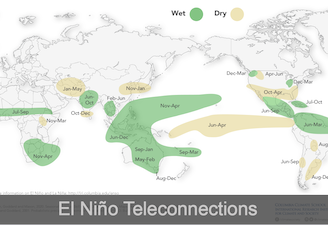
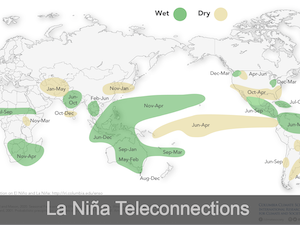
Once developed, El Niño and La Niña events typically persist for about a year and so the shifted rainfall patterns associated with them typically persist for several seasons as well. This can have a significant impact on people living in areas of the tropical Pacific since the usual precipitation patterns can be greatly disrupted by either excessively wet or dry conditions. In addition, the shifting of tropical rainfall patterns during El Niño and La Niña not only affects the tropical Pacific region but areas away from the tropical Pacific as well. This includes many tropical locations as well as some regions outside the tropics in both the Northern and Southern Hemispheres. For information about why this happens, see the ENSO and Climate section.

Seasonal climate forecasts made possible

The persistence of tropical sea surface temperature (and rainfall) patterns (such as those associated El Niño and La Niña) plays a fundamental role in making seasonal (3-month) climate forecasts possible. In the absence of El Niño and La Niña, seasonal climate forecasts are still possible because unusually warm or cold sea surface temperatures in other parts of the tropics can still occur. For more details on seasonal climate forecasts, see Forecasting Climate .