CCSR/IRI ENSO Forecast
CCSR/IRI Technical ENSO Update and Model-Based Probabilistic ENSO Forecast
Published: August 21, 2014
Recent and Current Conditions
The SST anomaly in the Nino3.4 region in recent weeks retreated from near the borderline of neutral and El Niño where it had been in May and June. For July the Nino3.4 SST anomaly was 0.18 C, indicative of neutral conditions, and for May-July it was 0.37 C. The IRI’s definition of El Niño, like NOAA/Climate Prediction Center’s, requires that the SST anomaly in the Nino3.4 region (5S-5N; 170W-120W) exceed 0.5 C. Similarly, for La Niña, the anomaly must be -0.5 C or less. The climatological probabilities for La Niña, neutral, and El Niño conditions vary seasonally, and are shown in a table at the bottom of this page for each 3-month season. The most recent weekly SST anomaly in the Nino3.4 region was 0.0 C, not far from the 0.18 C observed in July. Although the SST had been near the borderline of weak El Niño conditions in May and June, the atmospheric participation in an El Niño-like pattern had been weak or absent. During August so far, neither ocean nor atmosphere has reflected El Niño conditions in a clear or obvious way, but the atmosphere is recently showing a renewed tendency toward El Niño development.
Expected Conditions
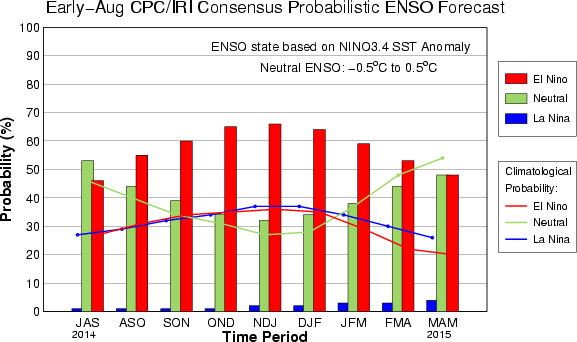
What is the outlook for the ENSO status going forward? The most recent official diagnosis and outlook was issued earlier this month in the NOAA/Climate Prediction Center ENSO Diagnostic Discussion, produced jointly by CPC and IRI; it called for a likelihood for a transition from neutral ENSO conditions to El Niño conditions during the early fall 2014 about to begin, with probabilities of El Niño rising to 66% for Nov-Jan 2014-15. The latest set of model ENSO predictions, from mid-August, now available in the IRI/CPC ENSO prediction plume, is discussed below. Currently, Nino3.4 SST anomalies are neutral after having been close to the borderline of El during May and June. Positive anomalies are still found in the far eastern part of the Pacific basin. Subsurface temperature anomalies across the eastern equatorial Pacific have been at average levels during the last month, after being much above average during spring but subsequently decreasing due to discharging into the atmosphere with strong positive SST anomalies in the far eastern part of the basin. In the atmosphere, the basin-wide sea level pressure pattern (e.g. the SOI) has recently shown a tendencies in the direction of El Niño, with a negative SOI, weak anomalous low-level westerlies and anomalous upper level easterlies. Anomalous convection (as measured by OLR) has been near average near and east of the dateline. These atmospheric conditions, while weak, are suggestive of El Niño despite the SST being neutral in recent weeks. Together, the oceanic and atmospheric features continue to reflect neutral ENSO conditions that lean toward weak El Niño.
As of mid-August, none of the dynamical or statistical models models predicts La Niña SST conditions for the initial Aug-Oct 2014 season, 44% predicts El Niño conditions, and 56% indicates neutral ENSO. At lead times of 3 or more months into the future, statistical and dynamical models that incorporate information about the ocean’s observed subsurface thermal structure generally exhibit higher predictive skill than those that do not. For the Nov-Jan 2014-15 season, among models that do use subsurface temperature information, 40% predicts ENSO-neutral SSTs, 60% predicts El Niño conditions and none predicts La Niña conditions. For all model types, the probability for neutral ENSO conditions is 40% or below between Oct-Dec 2014 and Apr-Jun 2015. Probabilities for El Niño rise to more than 60% or more between these same two seasons, peaking at 71% for Dec-Feb 2014-15. No model predicts La Niña conditions for any of the 3-month periods between Aug-Oct 2014 and Apr-Jun 2015.
Note – Only models that produce a new ENSO prediction every month are included in the above statement.
Caution is advised in interpreting the distribution of model predictions as the actual probabilities. At longer leads, the skill of the models degrades, and skill uncertainty must be convolved with the uncertainties from initial conditions and differing model physics, leading to more climatological probabilities in the long-lead ENSO Outlook than might be suggested by the suite of models. Furthermore, the expected skill of one model versus another has not been established using uniform validation procedures, which may cause a difference in the true probability distribution from that taken verbatim from the raw model predictions.
An alternative way to assess the probabilities of the three possible ENSO conditions is more quantitatively precise and less vulnerable to sampling errors than the categorical tallying method used above. This alternative method uses the mean of the predictions of all models on the plume, equally weighted, and constructs a standard error function centered on that mean. The standard error is Gaussian in shape, and has its width determined by an estimate of overall expected model skill for the season of the year and the lead time. Higher skill results in a relatively narrower error distribution, while low skill results in an error distribution with width approaching that of the historical observed distribution. This method shows probabilities for La Niña near 0% from Aug-Oct 2014 through Jan-Mar 2015, rising to 4% by Apr-Jun. Model probabilities for neutral ENSO conditions are 58% for the initial period of Aug-Oct 2014, 44% for the next running period of Sep-Nov, reach a low of 27% for Dec-Feb 2014-15 and rise to 45% by Apr-Jun 2015. Probabilities for El Niño are 42% for Aug-Oct 2014, rise to 73% for Dec-Feb 2014-15, and decline dlowly to 51% for Apr-Jun 2015. The models collectively favor El Niño over other ENSO conditions by a clear margin between Oct-Dec 2014 and Feb-Apr 2015. A plot of the probabilities generated from this most recent IRI/CPC ENSO prediction plume using the multi-model mean and the Gaussian standard error method summarizes the model consensus out to about 10 months into the future. The same cautions mentioned above for the distributional count of model predictions apply to this Gaussian standard error method of inferring probabilities, due to differing model biases and skills. In particular, this approach considers only the mean of the predictions, and not the total range across the models, nor the ensemble range within individual models.
The probabilities derived from the models on the IRI/CPC plume describe, on average, a likely development of El Niño development during Sep-Nov 2014, becoming even more likely by Oct-Dec. The consensus of model predictions calls for a weak El Niño event, a moderate event being second most likely, no El Nino being next most likely, and a strong event being least likely. A caution regarding this latest set of model-based ENSO plume predictions, is that factors such as known specific model biases and recent changes that the models may have missed will be taken into account in the next official outlook to be generated and issued in early October by CPC and IRI, which will include some human judgement in combination with the model guidance.
Climatological Probabilities
| Season |
La Niña |
Neutral |
El Niño |
| DJF |
37% |
28% |
35% |
| JFM |
34% |
37% |
29% |
| FMA |
30% |
48% |
22% |
| MAM |
26% |
54% |
20% |
| AMJ |
24% |
54% |
22% |
| MJJ |
25% |
51% |
24% |
| JJA |
25% |
50% |
25% |
| JAS |
27% |
46% |
27% |
| ASO |
29% |
40% |
31% |
| SON |
32% |
34% |
34% |
| OND |
34% |
31% |
35% |
| NDJ |
37% |
27% |
36% |