Top Stories
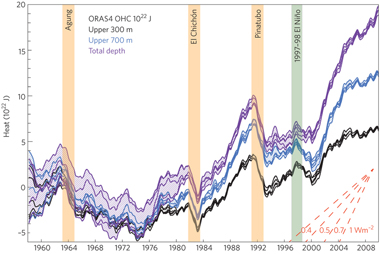
Has Global Warming Stalled? How Long Will It Last?
In the March issue of Nature Climate Change, IRI Director Lisa Goddard explains what may be behind the recent slowdown in global temperature increase in a piece titled “Heat Hide and Seek”. The Earth Institute interviewed Goddard for some additional thoughts in a recent Q&A.
EVENT: March 20, 3PM GMT/11AM EDT
Join Lisa Goddard and other experts in a live Google hangout about the science and communication of climate change over the past two decades. The event is sponsored by Nature Climate Change and Nature Geoscience. You can also ask your questions on Twitter with hashtag #NPGjclub.
Likelihood of El Niño Increases
IRI's joint forecast with the National Oceanic and Atmospheric Administration puts the odds of an El Niño developing by late summer at more than 50 percent. We explain how scientists make these forecasts and more in our latest story.
Do you have a question about
El Niño or La Niña? Tweet @climatesociety using #ENSOQandA, and we’ll do our best to get an answer for you.
Published & Noteworthy
|
|
|

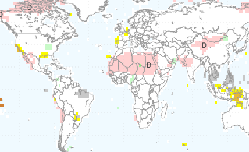
Few countries in Africa have the capability to routinely provide the public health community with the timely climate information it needs for decision making. A new approach developed at IRI called “Enhancing National Climate Services”, or ENACTS, is changing this, one country at a time. Tufa Dinku and colleagues discuss their recent collaboration with Tanzania's Meteorological Agency to launch a suite of new climate tools and services designed to inform the country's malaria prevention and control efforts.
"ENACTS is helping to address the trend of a declining number and quality of weather stations in many parts of Africa," says Dinku, "It has the potential to transform the capacities of national meteorological services so that they play an increasingly impactful role in national level decisions made by health, agriculture, water and other sectors."
|
|
A new paper describes a series of experimental games designed by IRI and partners to gauge demand by farmers for weather index insurance in the Tigray region of Ethiopia. The games, played in 2010, offered an insurance contract virtually identical to the commercial products later sold in the region. There were some surprising findings. First, farmers chose to pay more money for more frequent insurance payouts—this went against the common wisdom that farmers always pay the least amount of money possible for the least insurance possible. Perhaps more surprising, choices that farmers made in the hypothetical games were nearly the same as choices they made in real-world commercial insurance purchases. "Our findings support growing concerns that the most important policy challenges surrounding index insurance may not be those about insufficient demand, but that the demand and scaling of insurance outstrips the rate of improvement of the products," write the authors.
Visit IRI's Financial Instruments Sector Team page to learn about how we're using satellite observations, games and other technologies to improve the livelihoods of farmers in Africa, Asia and Central America.
|
|
|
|
|